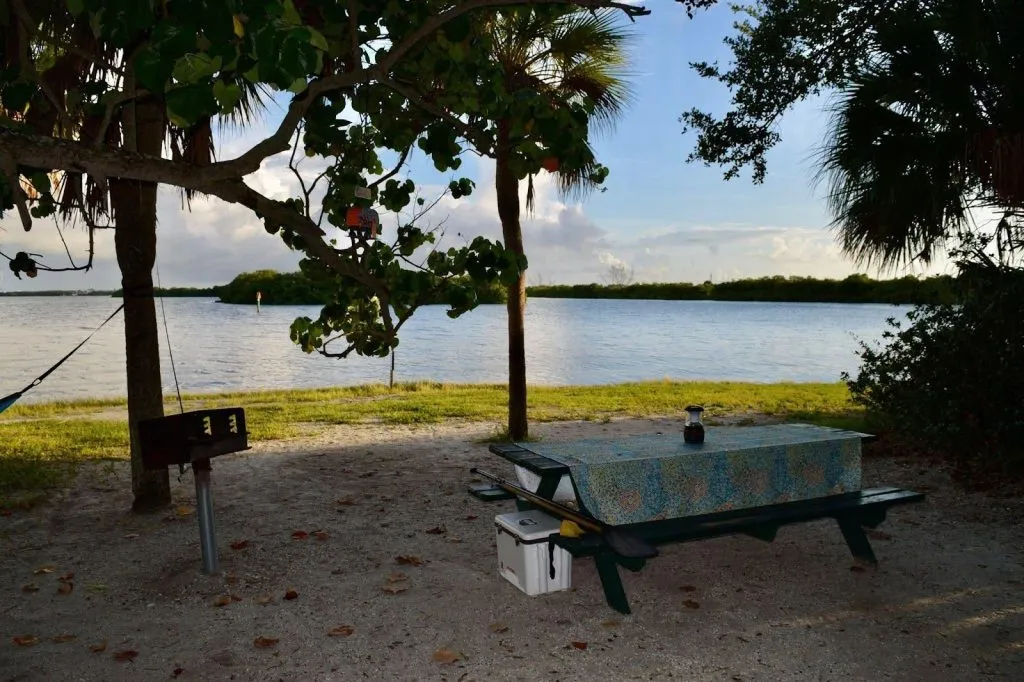
Wall Springs Park: A Local's Complete Visitor Guide
A local's complete guide to Wall Springs Park in Palm Harbor, FL — the 74° spring, the rebuilt observation tower, trails, wildlife, hours, and the best time to visit.
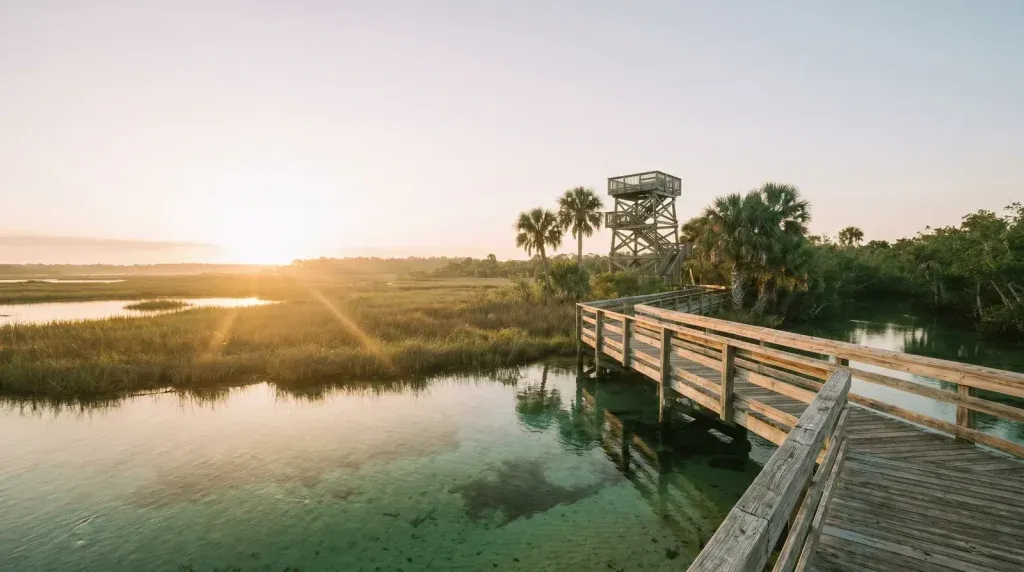
If you time it right, you'll get to the top of the tower at Wall Springs Park just as the tide comes in, and there'll be dolphins rolling through Boggy Bayou below you while the sun drops over the Gulf. That's the version of this park most visitors never see, because nobody told them when to show up.
This is the guide that tells you.
Wall Springs Park is a 210-acre Pinellas County coastal park in Palm Harbor, Florida, built around a historic natural spring that flows a constant 74 degrees. It's open 7 a.m. to sunset with free admission, and it has a boardwalk over the spring, a 35-foot observation tower, paved nature trails, a fishing pier, and a butterfly garden along the bayou. You can't swim in it — and there's a real story behind why.
The fast answers
Before the history and the planning, here's what most people are actually searching for:
- Is it free? Yes. Admission and parking are both free.
- Can you swim? No. Swimming is not allowed (more on why below — it's a good story).
- Are dogs allowed? Yes, on a leash.
- Hours? 7 a.m. to sunset, every day, except the day after Thanksgiving and December 25.
- Where is it? 3725 DeSoto Boulevard, Palm Harbor, FL 34683. The Coastal Addition has its own entrance at 621 Wai Lani Road.
- How big? About 210 acres total, and it connects straight to the Pinellas Trail.
That covers the quick decision. If you're still reading, you're the kind of person who likes to know what they're walking into — so let's get into it.
The full story of the spring (and why you can't swim)
People have been coming to this spring for a very long time, and for most of that history, they came to get in the water.
Charles F. Wall acquired the spring in the 1880s — that's where the park gets its name — and by the turn of the century it was already a known recreation spot. In 1927 the Wall family sold it to a New York entrepreneur named Harry Davis, who had bigger plans. Davis renamed it "Health Springs" and started printing handbills claiming the water could soothe high blood pressure, kidney and bladder trouble, and inflamed joints. Florida springs were marketed as cure-alls in those days, and people drove out to soak in them.
In the late 1940s the spring changed hands again, this time to the Cullen family of Palm Harbor. They switched the name back to Wall Springs and ran it as a straightforward swimming and recreation spot — they added a volleyball court, horseshoe pits, a baseball field, picnic shelters, and walking paths. For a couple of decades, this was the place locals cooled off.
Then in 1966 the Cullens closed the spring to the public. Not because anything dramatic happened — because insurance and liability had gotten too expensive for a family to carry. The swimming era was over.
Pinellas County started acquiring the land in 1988 and turned it into the public park you visit today. And the county made the swimming ban permanent, this time for the spring's sake: it's an environmentally sensitive system, and keeping bodies out of it protects the water and the wildlife that depends on it. So when you stand on the boardwalk and look down into that clear water and think this would be perfect to jump into — you're right, it would be, and that's exactly the instinct the rules are there to resist.
(One local note: old-timers will still call it Health Springs now and then. Now you know why.)
The 74-degree spring today
The spring itself is the heart of the park, and it's genuinely impressive once you understand the numbers.
It runs at a constant 74 degrees Fahrenheit year-round, cool and steady no matter what the air is doing. During the rainy season it can push out as much as 10.7 million gallons a day; in a drought it slows to a trickle. A boardwalk takes you right out over the spring run and the lagoon it feeds, which is where a lot of the bird activity concentrates. Stand there for a few minutes and you'll usually spot something working the shallows: a heron stalking, mullet flicking the surface, sometimes a turtle holding still on a log.
You won't be swimming, but the boardwalk is the best seat in the house for actually seeing the spring. The clarity of the water, the spillway, the way it moves out toward the bayou: that's the payoff here, and it costs you nothing.
The tower that burned down and came back
Here's the part of the park most guidebooks skip entirely.
The observation tower you'll climb today is not the original. The first tower was destroyed by arson in September 2013 — somebody set fire to it and burned it to the ground. For years afterward the park had a missing landmark.
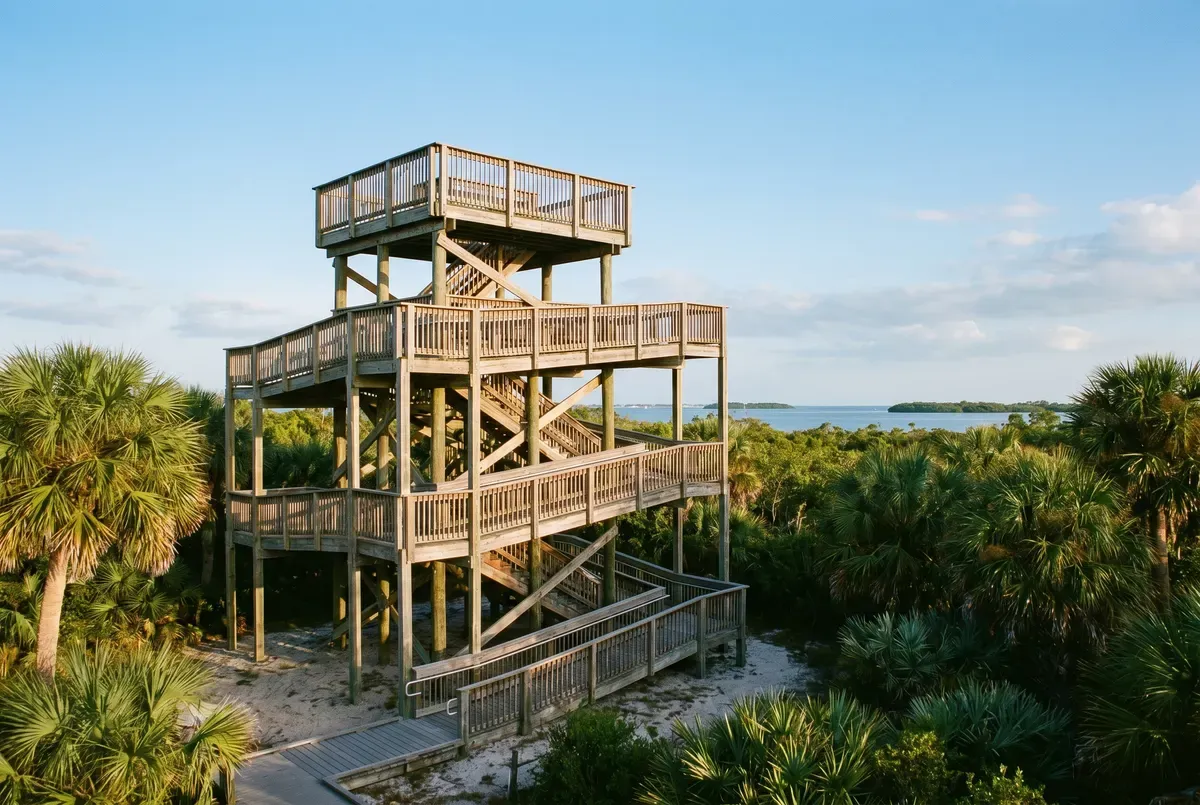
The rebuilt observation tower, with ADA ramps to two viewing decks. (Illustrative image, AI-generated.)
The county rebuilt it, and they didn't do it cheap or fast: the replacement is a 35-foot tower that cost about $1.7 million and reopened in the summer of 2018. It was built fully ADA-accessible, with zigzagging ramps that switchback up to two wraparound viewing decks. The view at the top is open to everyone, not just people who can manage a staircase.
And the view earns the climb. From the top you're looking out over the treetops and the mangrove channels toward the Gulf and the offshore islands. It's the single best vantage point in the park, and it's where you want to be at sunset.
What you'll actually see: wildlife and trails
Every listing for this park promises "wildlife." Here is what that actually means on the ground.
Dolphins work the deeper parts of Boggy Bayou, and your best odds are at high tide when they follow the water in. Manatees come into these waters too — the park posts signs about them, and cooler months are your better bet. The lagoon and the mangrove edges are full of wading birds: egrets, osprey, herons, ducks, and the pelicans that dive in the bayou. The butterfly garden is a roped-off pocket of native plants with a paved path around it, and it's worth the two-minute detour.
For walking, the main loop is roughly 1.2 miles and largely paved, easy enough for strollers and wheelchairs along most of its length. The Coastal Addition — the newer section with its own entrance off Wai Lani Road — adds natural-surface trails and a longer paved multi-use path out toward Gulf-side observation decks. That section is wilder and quieter.
One honest heads-up the brochures won't give you: after the 2024 hurricanes pushed saltwater inland, parts of the wooded areas turned into what hikers call a "ghost forest" — oaks and pines that died off, leaving mostly cabbage palms and a few tough slash pines standing. It's a little stark in spots now, and it's a real, visible reminder of what these storms do to coastal habitat.
Plan your visit
This is the part that separates a good visit from a frustrating one. Here's the playbook:
| Question | The local answer |
|---|---|
| Best time of day | Early morning for cool air and birds; late afternoon into sunset for the tower view. |
| Best for wildlife | High tide brings dolphins into the bayou; cooler months are better for manatees. |
| Parking | Free, in a one-way loop near the restrooms. It fills up on nice weekends — get there before mid-morning on a Saturday. |
| What to bring | Water and snacks (there are no concessions), sunscreen, bug spray, a hat. Fishing gear if you plan to fish. |
| Fishing | Allowed from the pier; you need a Florida saltwater fishing license. |
| Accessibility | Main loop, boardwalk, and the tower are all ADA-accessible. |
| Dogs | Welcome on a leash. |
| Watch your step | Rattlesnakes have been reported on the trails, especially in the wilder northern and Coastal Addition sections. Stay on the path, keep dogs leashed, and you'll be fine. |
| How long to stay | One to two hours covers the main park comfortably; add time if you walk the Coastal Addition. |
💡 The one move locals swear by
Come about ninety minutes before sunset: walk the boardwalk and the spring while the light is good, then be on the observation tower as the sun drops over the Gulf. That's the visit people remember.
Make a day of it
One of the quiet advantages of Wall Springs Park is where it sits. It connects directly to the Pinellas Trail, the county's long paved rail-trail, so you can roll a bike ride into your visit and cover serious ground on either side of the park.
And when you're done, you're a few minutes from some of the best low-key food in North Pinellas. Downtown Ozona and Old Palm Harbor are right there, full of the kind of waterfront spots and local kitchens that don't show up on the tourist lists. (We're building out full local guides to those — coming soon to Palm Harbor Happenings.)
If you want to make a real afternoon of it: park, walk the spring and the boardwalk, climb the tower, then drive five minutes to Ozona for an early dinner. That's a Saturday well spent.
And if you've got a whole day and don't mind a short drive, historic downtown Brooksville — about forty minutes north in Hernando County — is another walkable pocket of old Florida worth wandering. The Hernando Beacon put together a local's walking guide to historic downtown Brooksville if you want a route.
📌 Key things to remember
- Free — admission and parking, 7 a.m. to sunset daily.
- No swimming, but the boardwalk is the best view of the 74° spring.
- Best light: arrive about 90 minutes before sunset and finish on the tower.
- Bring water — there are no concessions. Leashed dogs welcome.
- Watch your step on the wilder trails — rattlesnakes have been reported.
Frequently asked questions
Can you swim at Wall Springs Park? No. Swimming is not allowed. The public swimming era ended in 1966, and the county keeps the ban in place to protect the environmentally sensitive spring.
Is Wall Springs Park free? Yes — both admission and parking are free.
Are dogs allowed at Wall Springs Park? Yes, leashed dogs are welcome on the trails.
How big is Wall Springs Park? About 210 acres total, including the newer Coastal Addition, and it connects to the Pinellas Trail.
How tall is the observation tower? 35 feet, with ADA-accessible ramps to two viewing decks and views toward the Gulf.
What are the hours? 7 a.m. to sunset daily, closed the day after Thanksgiving and on December 25.
Can you fish at Wall Springs Park? Yes, from the pier — a Florida saltwater fishing license is required.
The honest bottom line
Wall Springs Park isn't a thrill ride or an all-day destination, and anyone who sells it that way is overselling. What it is: a genuinely beautiful, free, easy-to-reach piece of old Florida with a real story under it — a spring people have loved for almost 140 years, a tower that burned and came back, and a bayou full of wildlife if you know when to look.
Go an hour and a half before sunset. Bring your own water. Climb the tower. You'll see why this one's been a local favorite since the 1880s.
Sources & official information
- Wall Springs Park — Pinellas County (official)
- Wall Springs Park trails — Florida Hikes
- Wall Springs Park — Wikipedia
Header and illustrative images on this page are AI-generated.