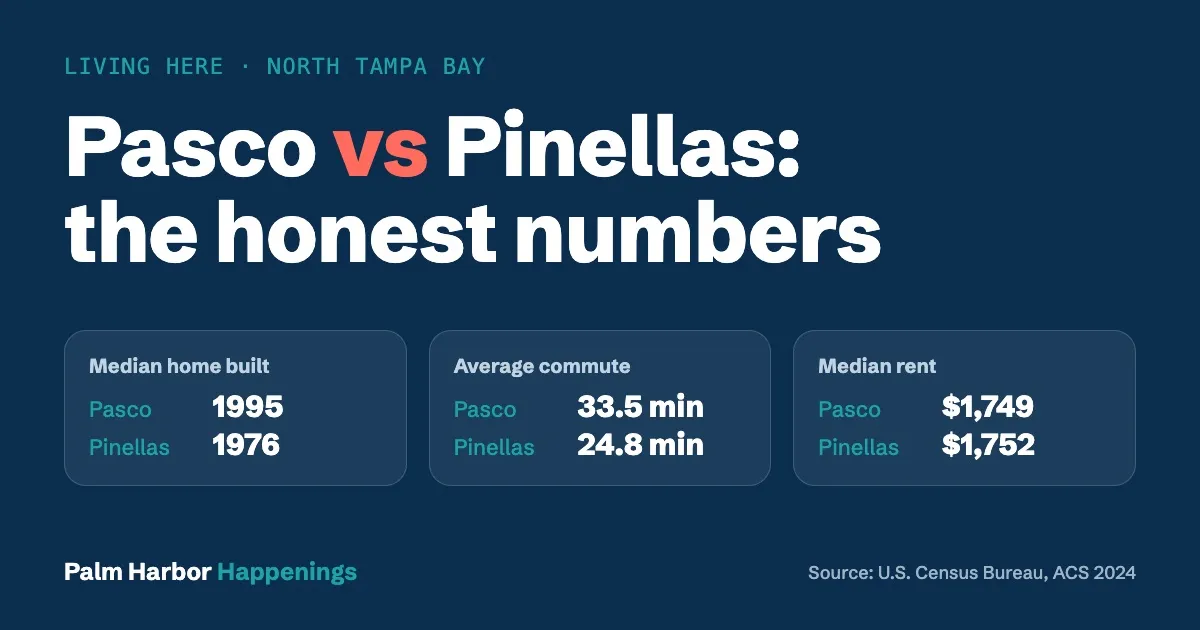
Pasco vs Pinellas: The Honest Numbers, From Right on the County Line
Pinellas County buys a shorter drive and the Gulf in an older, pricier house. Pasco County buys a newer house and more land, paid for in drive time.
Drive north on US-19 from Palm Harbor, through Tarpon Springs and over the Anclote River, and a couple of minutes later the signs change. You’re in Holiday now, in Pasco County. From East Lake it’s even quicker: Trinity’s subdivisions start where Pinellas stops.
That’s why “Pasco or Pinellas?” is a practical question up here. For a lot of people shopping for a house in north Tampa Bay, the two options are ten minutes apart, and the price tags, tax bills, and commutes on either side of that line are not what most people expect.
So we pulled the numbers. Census data, both property appraisers’ millage tables, FEMA’s flood insurance records, the state’s school grades, and the court record from the time Pinellas County fought Pasco all the way to the Florida Supreme Court over property taxes. Everything is linked so you can check it.
A note on where we sit: Palm Harbor Happenings is a North Pinellas publication. We live on one side of this line. We’ve tried hard to give Pasco every win it has earned, and it has earned several.
The short answer
Pasco vs Pinellas comes down to time versus house age. Pinellas is older, denser, and about 17% pricier at the median, with shorter commutes and the Gulf beaches. Pasco is newer and less crowded, with a median home built 19 years later, but its workers commute about 9 minutes longer each way, and nearly 4 in 10 work in another county.
Rent is a tie. Household income is a tie. The sales tax is a tie. The property tax on the same house is closer than the county rates suggest. And “Pasco” isn’t one price: parts of it cost less than half of Palm Harbor, and parts of it cost more.
Pasco vs Pinellas, side by side
Every number below comes from a public source, listed under the table. The housing, income, and commute figures come from the Census Bureau’s American Community Survey 2024 1-year release, the newest county-level release at the time of writing.
| Pinellas | Pasco | |
|---|---|---|
| Population, July 2025 | 948,563 | 674,516 |
| Change since April 2020 | −1.1% | +20.0% |
| Land area | 274 sq mi | 747 sq mi |
| People per square mile | about 3,460 | about 900 |
| Median age | 49.2 | 43.0 |
| Residents 65 and older | 27.5% | 21.7% |
| Median household income | $73,832 | $72,335 |
| Median home value | $398,400 | $341,500 |
| Median gross rent | $1,752 | $1,749 |
| Median year home was built | 1976 | 1995 |
| Homes built before 1990 | 77.8% | 43.6% |
| Homes built 2000 or later | 13.2% | 42.7% |
| Average one-way commute | 24.8 min | 33.5 min |
| Commutes of 45 minutes or more | 12.9% | 30.6% |
| Workers employed in another Florida county | 11.3% | 38.8% |
| Total millage, unincorporated homestead (2025) | 18.05 (Palm Harbor) | 16.82 (with fire district) |
| Tax on a $350,000 homestead (2025) | $5,565 | $5,194 |
| Sales tax | 7% | 7% |
| Residential NFIP flood policies | 76,020 | 23,604 |
| School district grade (2026) | A | A |
| Gulf beaches | 35 miles | a couple of small park beaches |
Sources: Census Bureau population estimates (Vintage 2025), American Community Survey 2024 1-year, Census TIGER land area, the Pinellas County Tax Collector and Pasco County Property Appraiser (2025 millage), Florida DOR (sales tax), FEMA OpenFEMA (flood policies, August 2026), the two school districts’ July 2026 releases, and Pinellas County (beach miles). Density and the tax bill are our own math. All are linked below.
Two of those rows surprise people more than the rest. Rent is the same to within three dollars. And Pinellas, the county people think of as “built out,” has a median house that’s 19 years older than Pasco’s. Hold onto that one; it shows up again in your insurance quote.
Money: what you pay on each side
Home prices: Pinellas costs more for an older house
The Census median home value is $398,400 in Pinellas and $341,500 in Pasco, a gap of about $57,000, or 17%. That’s an owner-reported value, so it moves slower than list prices, but it uses the same method on both sides of the line, which is the point of a comparison.
That median hides something. In Pinellas, the extra money mostly buys location. The median Pinellas home was built in 1976. The median Pasco home was built in 1995. At the median, Pasco gets you a house 19 years newer for about $57,000 less.
Rent: a dead heat
Median gross rent is $1,752 in Pinellas and $1,749 in Pasco. That’s within three dollars across the whole county.
If you’re renting and you’d move to Pasco to save money, the county average says you won’t, at least not automatically. You’ll save in specific places, and you’ll pay more in others, the same as you would anywhere.
Property taxes: the same $350,000 house in both counties
This is where the county rates mislead people. Pasco’s county commission rate for the 2025 tax year was 7.4042 mills, and Pinellas’s general fund rate was 4.5423 mills, according to the Florida Department of Revenue’s levy tables. Read those two numbers alone and Pasco looks 60% more expensive.
It isn’t, because the two counties slice the bill differently. Pinellas splits services into separate levies (an MSTU for unincorporated areas, EMS, a transit levy, fire districts, the Juvenile Welfare Board). Pasco rolls more of that into the county rate. The only fair comparison is the total millage on an actual address.
So we ran one. Same house, $350,000 just value, homesteaded, first year of ownership, 2025 rates:
| Address type | Total millage | Annual tax |
|---|---|---|
| Palm Harbor (unincorporated Pinellas) | 18.0529 | $5,565 |
| Unincorporated Pinellas, base area | 15.3229 | $4,748 |
| Unincorporated Pasco, with fire district | 16.8169 | $5,194 |
| Unincorporated Pasco, no fire district | 14.6944 | $4,559 |
| City of New Port Richey (Pasco) | 22.4892 | $6,892 |
How we did the math: the first $25,000 of value is exempt from every levy, and a second exemption (indexed to inflation since 2025, worth $25,722 for the 2025 tax year) comes off everything except school taxes. So the school levy applies to $325,000 and everything else applies to $299,278. On the Palm Harbor line, that’s $2,045 in school taxes plus $3,519 for everything else. Rates come from the Pinellas County Tax Collector’s 2025 millage table and the Pasco County Property Appraiser’s certified 2025 table. This leaves out non-ad valorem charges (trash, stormwater, community development districts) and the 4% discount for paying in November.
Three things fall out of that table:
- On the same house, Palm Harbor pays about $370 a year more than unincorporated Pasco with a fire district. That’s real money, and it’s a smaller gap than the county rates suggest.
- A Pasco city address can cost more than Palm Harbor. New Port Richey’s total rate is 22.49 mills, so the same house there runs about $1,330 a year more than in Palm Harbor. Zephyrhills (22.66) and Dade City (23.03) are in the same range. “Pasco has lower taxes” is true for unincorporated Pasco, not for its cities.
- The bigger savings come from the cheaper house. At each county’s median value ($398,400 in Pinellas, $341,500 in Pasco), the Palm Harbor bill is about $6,440 and the unincorporated Pasco bill is about $5,050. Most of that $1,390 gap is the price of the house, not the rate.
One note on timing: Pasco has already certified its 2026 rates, and the unincorporated fire-district total dropped slightly, to 16.6966 mills. Pinellas cut its general fund rate again for 2026, to 4.4989 mills, its lowest level since 1989, but its full 2026 table by tax area wasn’t posted when we checked. We’ll update the comparison when it is.
The line on the tax bill that the listing doesn’t show
If you’re looking at newer subdivisions in Pasco, especially along SR 54 and in Wesley Chapel, check for a community development district, or CDD. A CDD is a special district that financed the roads, ponds, and amenities in a new community, and it bills homeowners through a non-ad valorem assessment on the property tax bill. It isn’t in the millage, so it isn’t in our table above.
Before you make an offer, pull the actual prior-year tax bill for that exact parcel from the property appraiser’s site and read the non-ad valorem section. That one line can erase the whole tax advantage.
Sales tax: identical
Both counties charge 7%: the state’s 6% plus a 1% county surtax, per the Florida Department of Revenue’s 2026 surtax table. Pasco’s surtax dates from January 1, 2005 and runs through 2039. Pinellas’s dates from 1990 and runs through 2029.
Time: the commute is where Pasco charges you
If Pinellas charges you in dollars, Pasco charges you in minutes.
The average one-way commute is 24.8 minutes for Pinellas workers and 33.5 minutes for Pasco workers. That’s 8.7 minutes more each way. For someone who commutes five days a week, 50 weeks a year, that’s about 72 extra hours a year on the road, close to two full work weeks.
The averages hide the long tail, and the long tail is the real story:
- Commutes of 45 minutes or more: 12.9% of Pinellas workers, 30.6% of Pasco workers. That’s about 1 in 8 against nearly 1 in 3.
- Commutes of an hour or more: 5.2% in Pinellas, 14.7% in Pasco.
- Working in another county: 11.3% of Pinellas workers, 38.8% of Pasco workers.
That last number explains the first two. Pinellas is mostly a place where people live and work in the same county. Pasco, especially its southern half, is a place where many people sleep and then drive to Hillsborough or Pinellas for work. Before you pick Pasco for the house, drive the commute at 7:30 on a Tuesday morning. A Sunday-afternoon test drive will lie to you.
All of these come from the ACS 2024 1-year tables. The commute-time figures exclude people who work from home (about 20% of workers in both counties); the place-of-work figure counts all workers. One more number that fits the pattern: 1.8% of Pinellas workers take transit, against 0.2% in Pasco. In Pasco, you drive.
The house itself: Pinellas is a 1970s county, Pasco is a 2000s county
This is the single biggest difference between the two counties, and you won’t see it in a listing photo.
| Decade built | Pinellas | Pasco |
|---|---|---|
| Before 1960 | 20.6% | 2.7% |
| 1960s | 14.0% | 5.5% |
| 1970s | 24.8% | 16.4% |
| 1980s | 18.5% | 18.9% |
| 1990s | 8.9% | 13.7% |
| 2000s | 6.0% | 20.5% |
| 2010s | 5.2% | 11.4% |
| 2020 or later | 2.1% | 10.9% |
Share of all housing units by decade built. Source: ACS 2024 1-year, table B25034.
Pinellas filled up early. Nearly 4 in 5 of its homes were built before 1990, and 1 in 5 before 1960. Pasco is the reverse: 43% of its homes were built in 2000 or later, and more than 1 in 10 were built in 2020 or later. In Pinellas, that newest group is 1 in 50.
Why that matters for your budget:
- Building codes. Florida’s statewide building code took effect in 2002. About 87% of Pinellas homes were built before 2000, against about 57% in Pasco. A house built under the modern code generally has stronger roof-to-wall connections, and features like that earn wind-mitigation credits on an insurance policy.
- Inspections and insurability. On older homes, many Florida insurers ask for a four-point inspection (roof, electrical, plumbing, HVAC) before they’ll write a policy, and a roof near the end of its life can be the difference between a quote and a decline. Budget for that inspection on most Pinellas houses. A good local home inspector can tell you before you’re under contract.
- What you’re buying. An older Pinellas house often sits on an established street with mature trees, close to everything. A newer Pasco house often has the open floor plan and the new roof, farther out. Neither is wrong. They’re different purchases.
- What kind of home. Pasco is a county of houses: 61.7% of its homes are single-family detached, against 47.4% in Pinellas. Pinellas has far more condos and apartments, with 18.7% of its homes in buildings of 20 or more units, against 4.6% in Pasco. Pasco also has more owners: 74.9% of its homes are owner-occupied, against 69.8% in Pinellas.
One surprise in the same data: Pinellas has about as many mobile homes as Pasco, roughly 50,600 to 48,000 (the gap is inside the survey’s margin of error). They’re a bigger share of Pasco’s housing (16.7%, or 1 in 6 homes) because Pasco has fewer homes overall, but in raw numbers the “mobile home county” label belongs to both.
Water: beaches, flood insurance, and storms
The beach gap is real
Pinellas has 35 miles of sandy beaches on 11 barrier islands, plus nearly 588 miles of total coastline. It also has more water inside its boundaries (about 593 square miles) than land (about 274). From Palm Harbor, Honeymoon Island is a few minutes away, and the Wall Springs Park boardwalk is closer than that. We keep a running Gulf beach and red tide report for exactly this reason.
Pasco’s Gulf shore is a different kind of coast: tidal marsh, mangrove, and fishing piers, with a couple of small park beaches at Hudson (Robert J. Strickland Memorial Park) and Green Key near New Port Richey. Pasco’s coastal parks, like Anclote Gulf Park in Holiday, are built more for fishing piers and boardwalks than for a towel and an umbrella.
A local detail worth knowing: Anclote Key is in both counties. According to the state’s park management plan, Three Rooker Island and the southern tip of Anclote Key are in Pinellas, and the rest of Anclote Key is in Pasco. Most of that island’s long, empty beach is technically Pasco’s.
If you live in inland Pasco and love the beach, plan on driving to Pinellas for it. Many Pasco residents do. Our things to do in Pinellas County guide has the county beaches with their hours and parking fees.
Flood insurance: Pinellas carries three times the policies
FEMA’s National Flood Insurance Program data (as of August 2026) shows 76,020 residential flood policies in Pinellas, covering 19.4% of its homes. Pasco has 23,604, covering 10.3%.
Pinellas is a peninsula with water on three sides, and nearly twice the share of its homes carry flood insurance. In Pasco, about 15.5% of residential structures sit in FEMA’s Special Flood Hazard Area, the mapped high-risk zone, so most Pasco homes sit outside it. (FEMA’s own count of Pinellas homes in that zone is internally inconsistent, so we’re not printing one.) Pasco also earns a Class 5 rating in FEMA’s Community Rating System, which takes 25% off flood premiums for policies in its high-risk zone.
The practical takeaway works in both directions. A house’s flood zone matters more than its county. A Pinellas house on high ground in Palm Harbor or East Lake can be a lower flood risk than a waterfront house in Hudson. Check the FEMA flood map for the exact address and get a flood quote before you fall for the kitchen.
Helene and Milton
Hurricane Helene’s storm surge in September 2024 hit the coast of both counties, and Milton followed two weeks later. By December 2024, Pinellas County had mailed more than 1,600 substantial-damage letters to homes in unincorporated areas alone. In Pasco, state and county damage teams canvassed the areas west of US-19.
Both counties use the same rule: if repairs cost 49% or more of a home’s value (without the land), the home is “substantially damaged” and has to be brought up to current flood rules, which often means elevating it. If you’re looking at a coastal house in either county, ask whether it received a substantial-damage letter and what was done about it. If storm water got into the mechanicals, our piece on HVAC systems after a flood explains what to check.
People: who lives on each side
Pinellas is older. Its median age is 49.2, and 27.5% of residents are 65 or older. Pasco’s median age is 43.0, with 21.7% at 65 and up. Neither county is young, but Pasco is younger, and the newest parts of it are much younger, as the town table below shows.
Household income is effectively the same: $73,832 in Pinellas and $72,335 in Pasco. The difference is smaller than the survey’s margin of error.
Density is where you’ll feel it every day. Pinellas packs about 3,460 people into each square mile. By the county’s own fast facts, it’s the most densely populated county in Florida, on the second-smallest land area. Pasco has about 900 per square mile. That’s why a Pinellas errand is five minutes and a Pasco errand can be fifteen, and why Pasco still has pasture and horse farms within the county limits.
And the two counties are moving in opposite directions. From April 2020 to July 2025, Pasco grew by about 112,600 people (20%). Pinellas lost about 10,500 (1.1%), including about 11,800 in the twelve months that took in the 2024 hurricane season. In both counties, deaths now outnumber births. So Pasco’s growth is all people moving in, while Pinellas’s one-year loss was roughly half people moving out and half deaths outpacing births.
Schools: both districts earned an A in 2026
In July 2026, Pinellas County Schools earned an A from the Florida Department of Education for the third year in a row. Pasco County Schools earned an A too, which the district called a historic milestone, with every school rated C or higher for the first time since 2004. The year before, Pinellas earned an A and Pasco a B, as WUSF reported when the 2025 grades came out.
One caution: a district grade tells you very little about the one school your address is zoned for. Look up the specific school’s grade, and visit.
On the county line: the towns you’re really choosing between
You move to a town, and the county comes with it. Up here on the line, the town-level numbers break the county averages wide open.
| Town | County | Median home value | Median year built | Avg. commute | Median age |
|---|---|---|---|---|---|
| East Lake | Pinellas | $488,000 | 1990 | 28.3 min | 51.2 |
| Trinity | Pasco | $459,800 | 2006 | 30.0 min | 42.5 |
| Palm Harbor | Pinellas | $405,300 | 1985 | 26.7 min | 50.9 |
| Wesley Chapel | Pasco | $403,700 | 2006 | 31.1 min | 37.1 |
| Dunedin | Pinellas | $396,000 | 1976 | 24.9 min | 58.0 |
| Oldsmar | Pinellas | $380,300 | 1988 | 24.7 min | 40.8 |
| Land O’ Lakes | Pasco | $377,400 | 1999 | 30.6 min | 43.1 |
| Tarpon Springs | Pinellas | $340,700 | 1984 | 28.5 min | 55.4 |
| Hudson | Pasco | $269,200 | 1984 | 34.7 min | 63.8 |
| Zephyrhills | Pasco | $224,700 | 1990 | 31.6 min | 48.8 |
| New Port Richey | Pasco | $183,100 | 1980 | 27.8 min | 53.6 |
| Holiday | Pasco | $170,100 | 1977 | 29.8 min | 45.8 |
Source: Census ACS 2024 5-year estimates (2020-2024), the most reliable release for towns this size. Palm Harbor, East Lake, Trinity, Land O’ Lakes, Wesley Chapel, Hudson, and Holiday are Census-designated places, not cities.
Read that table top to bottom and “Pasco is cheaper” falls apart. Trinity’s median home value is higher than Palm Harbor’s, and Wesley Chapel is level with it. Meanwhile, Holiday and New Port Richey, just across the line on US-19, have median values less than half of Palm Harbor’s.
So Pasco is really at least three different markets:
- West Pasco, along US-19 (Holiday, New Port Richey, Port Richey, Hudson): older homes from the 1970s and 1980s, the lowest prices on our list, the shortest drive into North Pinellas, and the closest thing Pasco has to a Gulf-coast town feel. Pasco County’s own planning maps treat the US-19 and Little Road corridor as its “West Market.”
- South-central Pasco, along SR 54 (Trinity, Starkey Ranch, Land O’ Lakes): newer master-planned neighborhoods, Palm Harbor-level prices, and quick access to Oldsmar, Tampa Road, and the Suncoast Parkway.
- East Pasco, along I-75 (Wesley Chapel, Zephyrhills, Dade City): the newest construction and the youngest population, built to face Tampa. Wesley Chapel’s median age of 37.1 is the lowest on our list. Dade City, the county seat, is still a small Florida courthouse town with farmland around it.
So if you’re deciding between Palm Harbor and Trinity, the county label barely matters. The real choice is a 1985 house with a 27-minute commute or a 2006 house with a 30-minute commute, and at the median the newer Trinity house costs about $55,000 more.
Things the two counties share (and one thing they fought over)
For two counties that like to tease each other, Pasco and Pinellas are tied together more tightly than most residents know.
The same courts. Florida law puts both counties in one judicial circuit. In the words of the statute, “The sixth circuit is composed of Pasco and Pinellas Counties.” They share one elected State Attorney, one Public Defender, and courthouses in Clearwater, St. Petersburg, New Port Richey, and Dade City.
The same water. Both counties buy their drinking water wholesale from Tampa Bay Water, at the same rate, along with Hillsborough, Tampa, St. Petersburg, and New Port Richey. It wasn’t always friendly. For decades, Pinellas and the big cities pumped from wellfields they owned outside their own borders, several of them in Pasco, and the fights over who drained whose wetlands became known as the “water wars.” The regional utility’s own history says its creation in 1998 ended them: it bought the members’ wellfields and started charging every member the same price.
The ranch Pinellas owns in Pasco. Pinellas County still owns about 12,400 acres inside Pasco, the Cross Bar Ranch and the Al Bar Ranch, bought in 1976 and 1989 for their water. For years, Pinellas paid property taxes on that land to Pasco. Then it stopped, arguing that one county can’t tax another, and the dispute went to court. In June 2024, the Florida Supreme Court ruled 4-2 in Pinellas County v. Joiner that sovereign immunity “does not” shield a county from paying property taxes on land it owns in another county. So Pinellas owes Pasco property taxes on its own ranch land, by order of the state’s highest court.
A shared family history. Pasco was carved out of Hernando County in 1887, with Dade City as its seat. Pinellas split from Hillsborough on January 1, 1912, after a local referendum, and made Clearwater its seat. Both started as somebody else’s back country, which may be why they still keep score.
So which one should you pick?
No county wins for everyone. Based on the numbers above, this is how we’d sort it:
Pinellas probably fits you better if:
- You work in Pinellas, or in Westshore and the airport side of Tampa.
- You want a Gulf beach a short drive away.
- You like density: restaurants, trails, festivals, and errands close together. (Our North Pinellas events calendar shows what a normal week looks like.)
- You’re comfortable with an older house and you’ll budget for inspections, a roof, and wind mitigation.
Pasco probably fits you better if:
- You want a newer, detached house, built under the modern code.
- You work in north Tampa, along I-75, or from home.
- You want land, quiet, and a slower pace, and you don’t mind driving for the beach.
- You’re buying in unincorporated Pasco and you’ve checked the parcel for CDD assessments.
Look hard at the county line if you want both. Trinity and East Lake, Holiday and Tarpon Springs: these pairs sit minutes apart. For a lot of buyers, the right move is to pick the town and let the county follow.
Whichever side you land on, talk to someone who works the area every day. Our local real estate agents, homeowners insurance agents, and movers are all in the Palm Harbor Happenings business directory. Once you move, our Pasco and Pinellas local resources page has the county numbers you will need: utilities, trash, animal services, the sheriff and more.
Frequently asked questions
Is Pasco County cheaper than Pinellas County? For buying, usually yes, but not everywhere. The Census median home value is $341,500 in Pasco and $398,400 in Pinellas. But Trinity’s median ($459,800) is higher than Palm Harbor’s, and Wesley Chapel’s matches it. For renting, the two counties are the same: median rent is $1,749 in Pasco and $1,752 in Pinellas.
Are property taxes lower in Pasco or Pinellas? On the same $350,000 homestead with 2025 rates, unincorporated Pasco (with a fire district) comes to about $5,194 a year and unincorporated Palm Harbor about $5,565, roughly $370 apart. Pasco’s cities run higher: the same house in New Port Richey would pay about $6,892. Always check for CDD assessments on newer Pasco homes.
Does Pasco County have beaches? A couple of small park beaches, at Hudson and Green Key, plus most of Anclote Key, an island preserve three miles offshore. Much of Pasco’s shore is tidal marsh and mangrove. Pinellas has 35 miles of sandy Gulf beaches.
Which county floods more? The county-level data can’t settle it. Pinellas has far more flood-insured homes (76,020 residential policies, 19.4% of homes, against 23,604 and 10.3% in Pasco), and about 15.5% of Pasco homes sit in FEMA’s high-risk zone. Flood risk is set by the address. Check FEMA’s flood map for the exact property.
Is Pasco County a good place to live? It depends on what you need. Pasco offers newer homes, more space, and an A-rated school district in 2026. The trade-off is time: Pasco workers average a 33.5-minute commute, and nearly 4 in 10 work outside the county.
Do Pasco and Pinellas share anything? Quite a lot. They share the Sixth Judicial Circuit (one State Attorney, one Public Defender), they both buy water wholesale from Tampa Bay Water at the same rate, and Pinellas County owns about 12,400 acres of ranch land in Pasco, on which the Florida Supreme Court ruled in 2024 that it owes Pasco property taxes.
How we built this
- Census figures come from the American Community Survey, pulled October 29, 2026. County numbers use the 2024 1-year release; town numbers use the 2024 5-year release because the 1-year sample is too thin for smaller places. Population totals and growth come from the Census Bureau’s Vintage 2025 county estimates. The average commute is total travel time divided by workers who don’t work from home.
- Tax math uses the certified 2025 millage tables from the Pinellas County Tax Collector and the Pasco County Property Appraiser, and the homestead rules in Florida Statute 196.031. It covers ad valorem taxes only.
- Flood policies come from FEMA’s OpenFEMA NFIP residential penetration dataset, as of August 3, 2026.
- Court and water history comes from the Florida Supreme Court’s opinion in Pinellas County v. Joiner (2024), the Second District Court of Appeal’s 2019 opinion in the same case, the Florida DEP’s 2026 Florida Forever plan, and Tampa Bay Water.
If you spot a number that has changed, tell us and we’ll fix it.